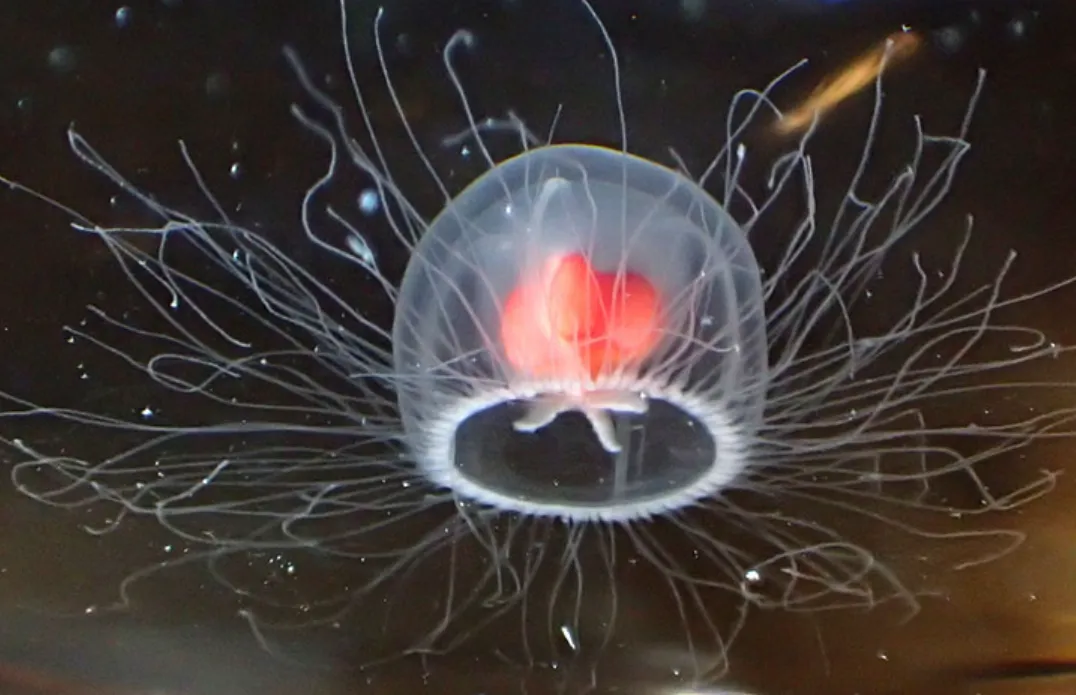
The immortal jellyfish’s life cycle is one of the most fascinating stories in marine biology. Known scientifically as Turritopsis dohrnii, this tiny hydrozoan has become famous because it can reverse its body from the adult medusa stage back into the young polyp stage under stress. That does not mean every immortal jellyfish lives forever, but it does mean this animal has a rare biological ability that challenges the normal idea of aging.
The immortal jellyfish is very small, often only around 4.5 mm across as an adult. It has a clear bell, a bright red manubrium, and many thin tentacles used to catch tiny prey. It is native to the Mediterranean Sea but is now found in many warm- and temperate-water oceans, likely aided by ship ballast water and hull fouling.
Scientists study the immortal jellyfish because its reverse life cycle may help explain cell repair, regeneration, aging, and tissue renewal. Its ability depends on transdifferentiation, a process where specialized adult cells can change into different cell types. This makes the immortal jellyfish’s lifespan biologically unusual, even though predators, disease, and environmental changes still kill many individuals in nature.
Q: What is the immortal jellyfish’s life cycle?
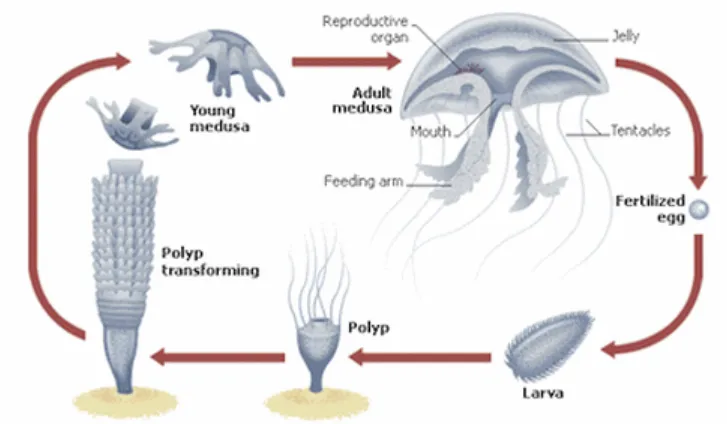
A: The immortal jellyfish life cycle starts as an egg, becomes a free-swimming planula larva, settles as a polyp, buds into a young medusa, grows into an adult, and can revert to a polyp when stressed.
Q: Is the immortal jellyfish really immortal?
A: It is biologically immortal in a special sense because it can restart its life cycle. But it can still die from predators, disease, injury, lack of food, or unsuitable water conditions.
Q: What is the size of the immortal jellyfish?
A: The adult immortal jellyfish size is tiny, about 4.5 mm across, roughly the size of a small fingernail.
Quick Life Cycle Table
| Life cycle stage | What happens | Main purpose | Survival advantage |
| Egg | Female medusa releases eggs, and male medusa releases sperm into the water | Starts sexual reproduction | Creates new genetic combinations |
| Planula larva | A fertilized egg becomes a tiny free-swimming larva | Searches for a surface | Helps the species spread |
| Polyp | Larvae attach to hard surfaces such as rocks, docks, or ship hulls | Grows as a colony | Can produce many cloned medusae |
| Medusa bud | Polyps form small buds | Asexual reproduction | Quickly increases population |
| Young medusa | Tiny jellyfish break free and enter the plankton | Feeding and growth | Can drift through the water column |
| Adult medusa | Becomes sexually mature in a few weeks, depending on water temperature | Produces eggs or sperm | Continues normal reproduction |
| Cyst stage | Under stress, the medusa shrinks into a tissue-like ball | Survival reset | Prepares the body for reverse development |
| New polyp | Cells reorganize into a polyp again | Restarts life | Makes the animal potentially biologically immortal |
The most important part of the immortal jellyfish’s life cycle is the return from adult medusa to polyp. Most jellyfish move forward through life and die after reproduction. Turritopsis dohrnii can reverse its developmental progression in response to starvation, physical damage, temperature changes, or salinity stress.
Important Things That You Need To Know
The immortal jellyfish is not a magic creature that cannot be killed. Its special power is biological reversal. When the adult body is damaged or stressed, it may collapse into a cyst-like state and rebuild itself into a young polyp. This is why people call it the immortal jellyfish, but the name can be misleading if taken too literally.
The immortal jellyfish’s lifespan is best described as “potentially indefinite” under the right conditions. In a safe lab setting, the cycle can be repeated many times. In the open ocean, however, an individual can be eaten by fish, sea turtles, sea anemones, other jellyfish, or sea slugs during the polyp stage.
The oldest immortal jellyfish is not officially known. Because these animals are extremely small and live in complex marine environments, tracking a single individual across multiple life-cycle reversals in the wild is almost impossible. So, no verified oldest individual has been recorded in the same way people record the oldest turtle or whale.
The size of the immortal jellyfish is also part of its mystery. A fully grown adult is only about 4.5 mm wide, yet it carries one of the most remarkable survival systems found in the animal kingdom. Its tiny body contains specialized cells that can reorganize during reverse development, making it a major subject in aging and regeneration studies.
For SEO and learning, remember these core terms together: immortal jellyfish, immortal jellyfish lifespan, the immortal jellyfish, oldest immortal jellyfish, and immortal jellyfish life cycle. These phrases all connect to one main idea: a tiny marine animal that can reset its body rather than follow a one-way path toward aging.
The History of Their Scientific Naming
The scientific name of the immortal jellyfish is Turritopsis dohrnii. It belongs to the phylum Cnidaria, class Hydrozoa, order Anthoathecata, family Oceaniidae, and genus Turritopsis. The accepted species name is Turritopsis dohrnii, with the authority listed as Weismann, 1883.
Important points in its naming history include:
• The species was originally described under the name Dendroclava dohrnii Weismann, 1883. Later, it was placed in the genus Turritopsis.
• The name Dohrnii honors Anton Dohrn, a major figure in marine science and the founder of the Zoological Station in Naples.
• For many years, some populations were confused with Turritopsis nutricula and other similar species. This happened because different Turritopsis species can look very similar.
• Modern taxonomy uses molecular evidence to separate species more accurately. Smithsonian records note that cryptic species may exist, and some can only be identified clearly through molecular methods.
This naming history matters because many online articles still mix up Turritopsis dohrnii with Turritopsis nutricula. For accuracy, the true “immortal jellyfish” discussed in most modern scientific writing is Turritopsis dohrnii.
Their Evolution And Their Origin
The origin of the immortal jellyfish is linked to the ancient success of cnidarians, a group that includes jellyfish, corals, sea anemones, and hydroids. These animals are relatively simple in body design compared with those of mammals, birds, or fish, but they are highly successful in the ocean. They use stinging cells called nematocysts, a simple body plan, and flexible life cycles to survive in many marine habitats.
Turritopsis dohrnii is believed to have originated in the Mediterranean Sea. From there, it has been reported in many other regions, including warm- and temperate-marine waters worldwide. One likely reason for this spread is human shipping. Tiny polyps can attach to ship hulls, and larvae or medusae may travel in ballast water. This kind of spread has been called a silent invasion because the animal is tiny and often unnoticed.
Evolution gave Turritopsis dohrnii a life cycle with both sexual and asexual stages. Sexual reproduction creates genetic diversity. Asexual budding from the polyp stage helps the animal multiply quickly. But its most unusual evolutionary feature is reverse development.
In normal development, animals grow from young forms into adults. In Turritopsis dohrnii, an adult medusa can return to a younger polyp stage. This reversal likely evolved as a survival response to stress. Instead of dying when food is low or conditions become harsh, the animal may reset its body and wait for better conditions.
Recent genetic studies suggest that genes involved in DNA repair, cell renewal, telomere maintenance, and stem cell-related activity may help explain this rejuvenation ability. A comparative genomics study of Turritopsis dohrnii and related cnidarians identified important molecular clues underlying its life-cycle reversal.
So, the immortal jellyfish’s life cycle is not just a strange trick. It is an evolved survival strategy built on cellular flexibility, simple body structure, and the ability to rebuild tissues.
Their main food and its collection process
The immortal jellyfish is a carnivorous animal. Even though it is tiny, it is an active predator in the planktonic food web. Its main food includes zooplankton, fish eggs, larvae, and small mollusks. It does not chew food like larger animals. Instead, it captures prey, moves it to the mouth, digests it in the stomach area, and releases waste through the same opening.
Its food collection process is simple but effective:
• Drifting through the water
The adult medusa floats and swims gently in the water column. While drifting, it keeps its tentacles ready to touch small prey.
• Using tentacles as traps
The tentacles contain nematocysts, which are stinging cells. When prey touches the tentacles, these cells fire, helping paralyze or immobilize the prey.
• Pulling prey toward the mouth
After catching prey, the tentacles flex and guide it toward the mouth. The food then enters the digestive cavity.
• Using bell movement
The jellyfish can expand and contract its bell. This movement helps it swim and can pull water and tiny prey closer to the tentacles.
• Feeding in the polyp stage
In the polyp stage, the animal is attached to a surface. It catches passing microscopic prey from the water. This stage can grow as a colony and later produce medusa buds.
Food is deeply connected to survival. If food becomes scarce, the adult medusa may enter a state of stress. In Turritopsis dohrnii, starvation can trigger reverse development, allowing the animal to return to the polyp stage rather than simply dying.
This feeding strategy also places the immortal jellyfish inside a larger ocean food network. It eats tiny animals, but larger predators eat it too.
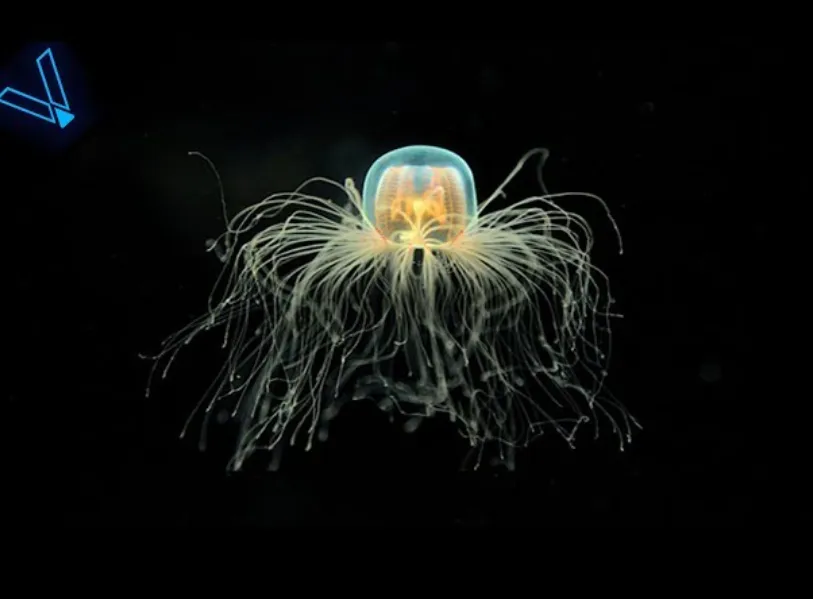
Their life cycle and ability to survive in nature
Egg to planula larva
The immortal jellyfish life cycle begins when adult medusae reproduce sexually. Female medusae release eggs, while male medusae release sperm into the water. After fertilization, the egg develops into a tiny free-swimming larva called a planula.
The planula does not stay free forever. It searches for a suitable hard surface to settle on. This may be the ocean floor, a rock, a dock, or even a ship hull.
Planula to polyp colony
Once attached, the planula becomes a polyp. The polyp stage is not free swimming. It stays fixed and grows into a hydroid colony. Smithsonian records describe these colonies as branched and capable of producing medusa buds.
This colony stage is important because it can produce many young jellyfish. All the medusae that arise from a single planula are genetically identical clones.
Polyp to medusa
Small buds grow from the polyp colony. These buds detach and become young medusae. At release, they are very small, around 1 mm. They then feed, grow, and become sexually mature in a few weeks. Water temperature affects the timing. Some records indicate maturity of 25 to 30 days at 20°C and 18 to 22 days at 22°C.
Medusa back to polyp
This is the stage that makes the immortal jellyfish famous. When the medusa faces stress, its bell contracts, its tentacles deteriorate, and it may form a cyst-like mass. Then, through transdifferentiation, its cells reorganize into a new polyp.
This process can restart the life cycle. In nature, however, survival still depends on avoiding predators, disease, pollution, extreme conditions, and food shortages.
Their Reproductive Process and raising their children
The reproductive process of Turritopsis dohrnii includes both sexual and asexual reproduction. This mixed strategy helps the species survive, spread, and rebuild populations in different marine conditions.
Key points include:
• Separate male and female medusae
The adult medusae have separate sexes. Males release sperm, and females release eggs into the water column. Fertilization usually happens outside the body.
• Formation of planula larvae
After fertilization, the egg develops into a planula larva. This stage is mobile and helps the species reach a suitable settlement place.
• Settlement on hard surfaces
The planula settles on rocks, docks, ship hulls, or other solid surfaces. After attaching, it becomes a polyp.
• Polyp colony growth
The polyp grows into a colony called a hydroid. This colony can produce many buds. These buds become young medusae.
• Asexual budding
Asexual reproduction occurs when a polyp colony forms medusa buds. This allows rapid population growth without needing fertilization each time.
• No parenting like mammals or birds
The immortal jellyfish does not raise its young with care, feeding, or protection. Instead, it depends on producing larvae and colonies that can survive on their own.
• Clonal offspring from polyps
Medusae produced from the same polyp colony are genetically identical. This gives the species a fast way to increase numbers when conditions are good.
• Reverse development as a survival backup
If the adult medusa is stressed, it may return to the polyp stage. This is not a normal reproduction, but it helps the same individual restart their life.
So, when people ask how the immortal jellyfish raises its children, the answer is simple: it does not provide parental care. Its success comes from a strong life cycle, rapid budding, and the ability to reset development.
The importance of them in this Ecosystem
Small predator in the plankton food web
The immortal jellyfish helps control tiny prey populations such as zooplankton, larvae, fish eggs, and small mollusks. By feeding on these organisms, it becomes part of the balance between microscopic life and larger marine animals.
Although it is small, it still has a role in moving energy through the ocean. It eats smaller animals and then becomes food for larger predators.
Food for larger marine animals
Fish, sea turtles, sea anemones, penguins, and other jellyfish can eat adult immortal jellyfish. In the polyp stage, they may be eaten by sea slugs. This means their body energy does not stay in one place. It moves upward into the marine food chain.
This makes Turritopsis dohrnii both predator and prey.
Indicator of marine movement and human impact
Because the species can attach to ship hulls and spread through ballast water, it also tells scientists something about human influence on marine ecosystems. Its global spread shows how small marine organisms can move quietly across oceans. Smithsonian records describe its distribution as likely connected to human-mediated introduction.
Scientific importance of aging and regeneration
The most famous importance of the immortal jellyfish is scientific. Its reverse life cycle gives researchers a living model for studying cell plasticity, regeneration, and aging. Studies on Turritopsis dohrnii do not mean humans can become immortal, but they may help scientists understand how cells repair, renew, and change identity.
Balance without major reported damage
Even though the species has spread to new regions, Smithsonian records state that no major impacts have been reported from introduced populations. Still, monitoring matters because marine ecosystems are sensitive, and small species can sometimes create unexpected effects over time.
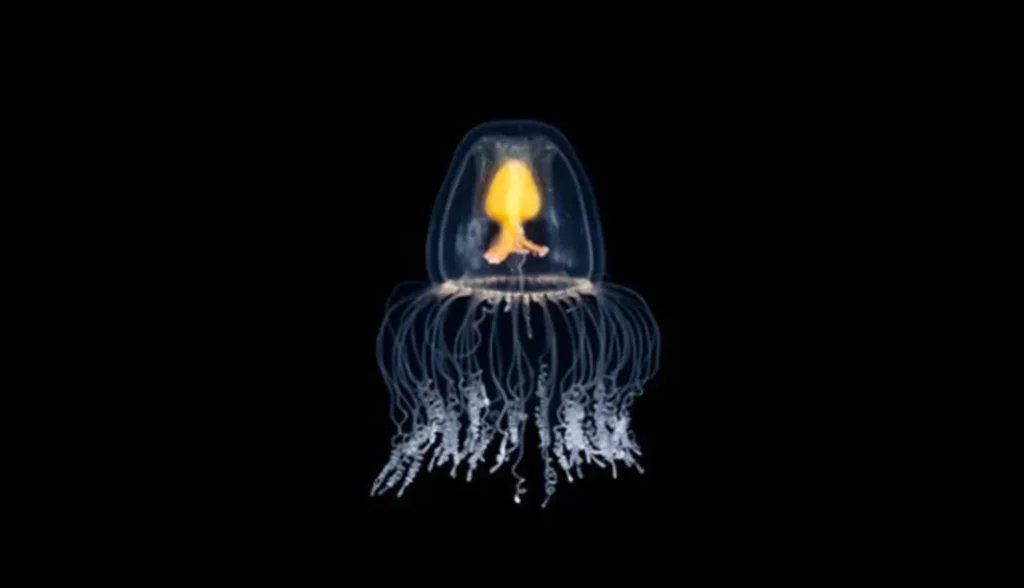
What to do to protect them in nature and save the system for the future
Protecting the immortal jellyfish also means protecting the ocean system where it lives. Since this animal depends on clean water, healthy plankton, and stable marine habitats, conservation should focus on the wider Ecosystem.
• Reduce plastic pollution
Plastic waste breaks down into microplastics that can harm plankton, larvae, and other tiny marine life. Cleaner oceans support the whole food web.
• Control ship ballast water carefully
Because Turritopsis dohrnii may spread through ballast water, ships should follow strong ballast water treatment rules to reduce unwanted movement of marine species.
• Protect coastal habitats
Docks, rocks, reefs, and shallow coastal structures can support polyp colonies. Healthy coastal zones help many species, not only jellyfish.
• Limit chemical runoff
Pesticides, oil, heavy metals, and industrial waste can damage plankton communities and harm small predators such as the immortal jellyfish.
• Support marine research
Scientists still do not know everything about the immortal jellyfish’s lifespan, genetics, and field behavior. More research can help explain its role in nature and medicine.
• Monitor silent invasions
Tiny marine organisms can spread unnoticed. Regular monitoring helps scientists understand whether introduced populations are harmless or harmful.
• Protect plankton diversity
The immortal jellyfish feeds on zooplankton and other small organisms. Protecting plankton means protecting the base of the marine food chain.
• Reduce ocean warming pressure
Climate change can affect water temperature, salinity, oxygen, and food availability. Reducing carbon emissions helps protect marine life cycles.
• Educate people with accurate information
Many people think the immortal jellyfish can never die. Clear education helps people understand the real science behind its reverse life cycle.
• Avoid unnecessary collection from the wild
Because the animal is tiny and scientifically valuable, collecting should be done only for responsible research.
Frequently Asked Questions (FAQs)
Q1: What is the immortal jellyfish’s life cycle?
A: The immortal jellyfish life cycle includes egg, planula larva, polyp, medusa bud, young medusa, adult medusa, and possible reverse development back to the polyp stage.
Q2: Why is it called the immortal jellyfish?
A: It is called the immortal jellyfish because the adult medusa can return to a younger polyp stage through transdifferentiation, which can restart its life cycle.
Q3: Can the immortal jellyfish live forever?
A: In theory, its life cycle can repeat many times. In nature, however, it can still die from predators, disease, injury, starvation, or harsh environmental conditions.
Q4: What is the immortal jellyfish’s lifespan?
A: The immortal jellyfish’s lifespan is potentially indefinite biologically, but no wild individual is known to live forever. Most individuals face natural dangers before they can repeat the cycle endlessly.
Q5: What is the size of the immortal jellyfish?
A: The adult immortal jellyfish size is about 4.5 mm across, making it one of the smallest known jellyfish-like animals.
Q6: What does the immortal jellyfish eat?
A: It eats zooplankton, fish eggs, larvae, and small mollusks. It catches prey with tentacles armed with stinging cells called nematocysts.
Q7: Where does the immortal jellyfish live?
A: It was first known from the Mediterranean Sea, but it is now found in warm and temperate waters around the world. It can live around docks, rocks, ship hulls, and coastal marine habitats.
Q8: What is the oldest immortal jellyfish ever found?
A: There is no confirmed record for the oldest immortal jellyfish. The species is too small and difficult to track in the wild, so scientists cannot easily verify the age of one individual.
Conclusion
The immortal jellyfish’s life cycle is a powerful example of nature’s strangeness and creativity. Turritopsis dohrnii begins life like many other hydrozoans, moving from egg to larva, then to polyp, and finally to adult medusa. But unlike most jellyfish, it can reverse this path when stressed and return to an earlier stage.
This ability makes the immortal jellyfish one of the most important animals for studying aging, regeneration, and cell flexibility. Still, it is not truly invincible. It can be eaten, harmed, or killed like any other small marine creature.
Its real wonder is not fantasy immortality. Its wonder is biological resilience. By understanding the immortal jellyfish’s lifespan, feeding habits, reproduction, and its role in the Ecosystem, we also learn more about ocean balance, evolution, and the hidden life of tiny marine animals. Protecting the ocean means preserving these rare natural mysteries for future generations.
Also Read: fish life cycle