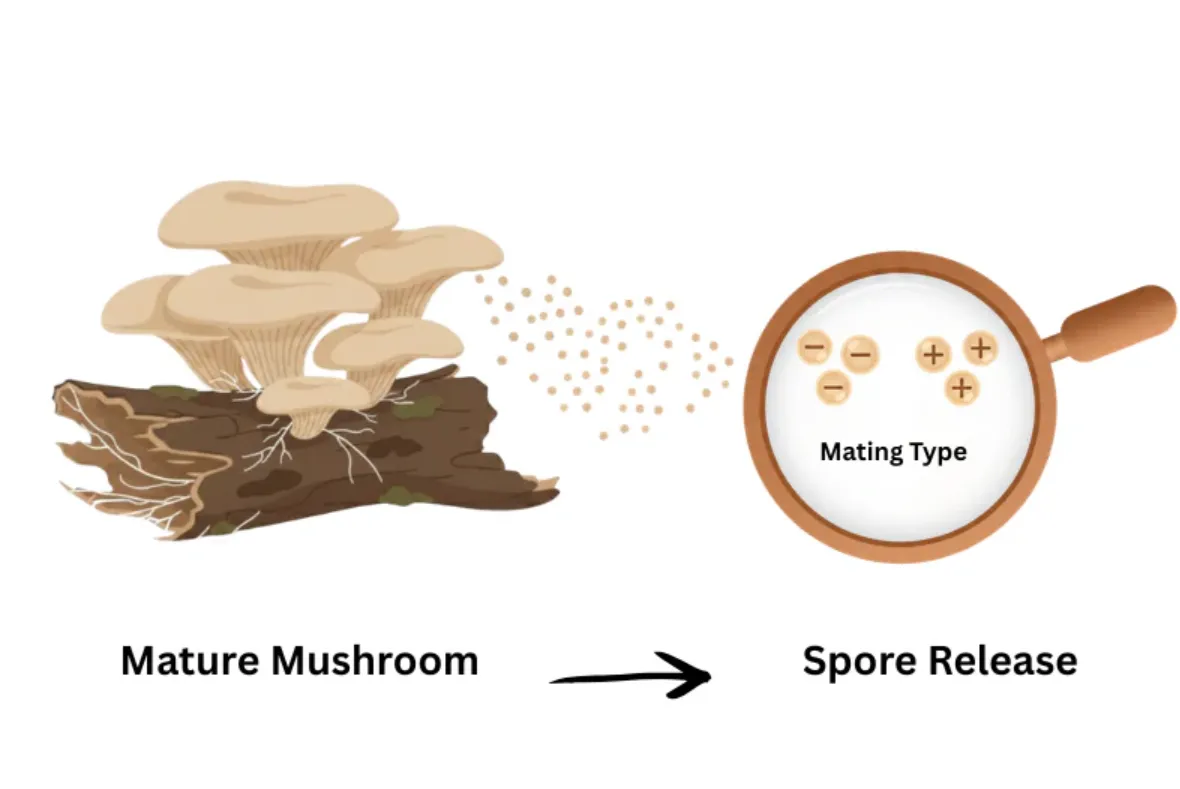
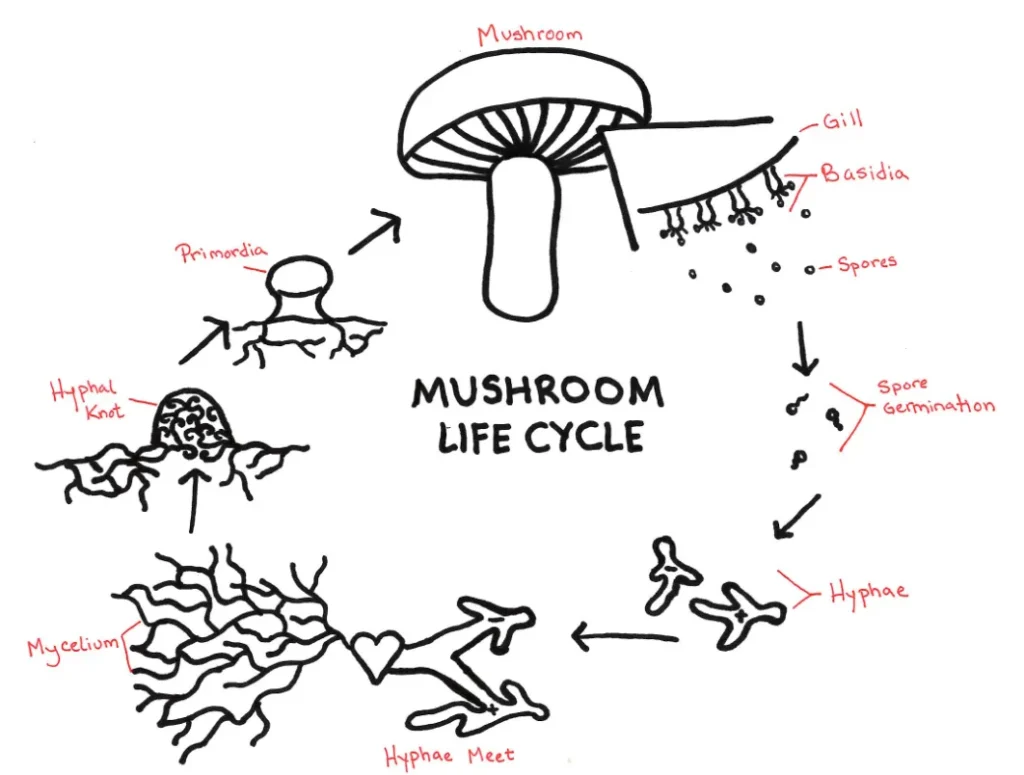
The mushroom life cycle is the natural process through which a mushroom begins as a tiny spore, develops into thread-like hyphae, forms a hidden feeding network called mycelium, and finally produces a visible fruiting body that releases new spores.
A mushroom is not the whole organism. It is mainly the reproductive structure of certain fungi. The true body of the fungus is usually the mycelium, which lives in soil, wood, compost, leaf litter, or other organic matter. Britannica describes mycelium as a mass of branched tubular filaments called hyphae, and notes that mushrooms, puffballs, brackets, truffles, and similar forms can develop from this fungal body.
Unlike plants, mushrooms do not make food by photosynthesis. They absorb nutrients by breaking down organic matter, forming partnerships with plants, or, in some cases, living as parasites. This is why fungi are essential in forests, farms, gardens, and natural ecosystems.
Q: What is the first stage of the mushroom life cycle?
A: The first stage is the spore stage. Spores are tiny reproductive cells released by mature mushrooms.
Q: Is the mushroom the whole fungus?
A: No. The visible mushroom is usually only the fruiting body. The larger living network is the mycelium.
Q: How does a mushroom reproduce?
A: A mushroom reproduces mainly by releasing spores, which can germinate and grow into new fungal networks when conditions are suitable. Fungi can reproduce sexually and asexually.
Important Things That You Need To Know
When people search for mushroom life cycle, they may also see terms like mushroom, Mellow Mushroom, mushroom coffee, Lion’s mane mushroom, enoki mushroom, shiitake mushroom, and mushroom gummies. These words are related to mushrooms in different ways, but they do not all mean the same thing.
Mushroom is the general word for the visible fruiting body of certain fungi. Lion’s mane, enoki, and shiitake mushrooms are edible varieties, each with distinct shapes, textures, and culinary uses. Shiitake is commonly used in Asian cooking, enoki has long, thin stems, and Lion’s mane has a white, shaggy appearance.
Mushroom coffee usually means coffee blended with mushroom extracts, while Mellow Mushroom is a restaurant brand name, not a biological term. Mushroom gummies need extra caution because some modern products are marketed as mushroom edibles even when their ingredients may be unclear or psychoactive. The FDA has warned that Amanita muscaria and its constituents are not authorized for use as ingredients in conventional food, and the agency recommends avoiding foods containing them.
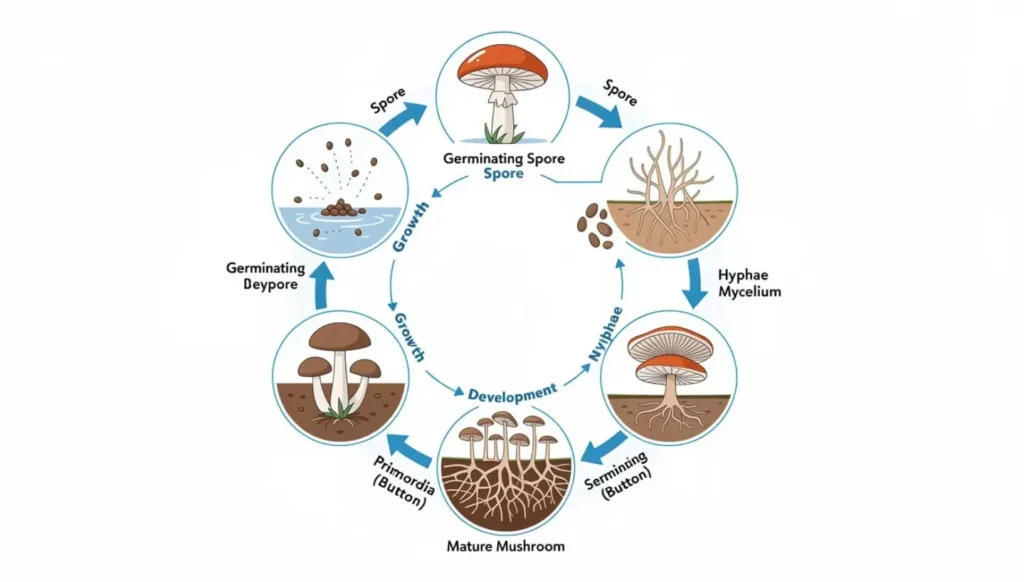
So, when learning about the mushroom life cycle, focus on the biological process: spore → hyphae → mycelium → fruiting body → spores again.
Quick Life Cycle Table
| Stage | What Happens | Main Purpose | Where It Happens |
| Spore | Tiny reproductive cells are released | Start new fungal growth | Air, soil, wood, compost |
| Hyphae | Spores germinate into fine threads | Search for food and moisture | Inside substrate |
| Mycelium | Hyphae form a web-like network | Absorb nutrients and grow | Underground or inside wood |
| Fruiting Body | A visible mushroom appears | Produce and release spores | Above soil, logs, compost |
The History of Their Scientific Naming, Evolution, and Origin
Scientific Naming of Mushrooms
The scientific study of fungi is called mycology. Mushrooms belong to the kingdom Fungi, not the plant kingdom. Many familiar mushrooms are placed in groups such as Basidiomycota and Ascomycota, depending on how they form spores.
The word mushroom is a common name, not a strict scientific category. It usually describes a visible, fleshy fruiting body that can be picked by hand.
Evolutionary Origin of Fungi
Fungi have a very ancient evolutionary history. Kew notes that fungi are one of Earth’s major kingdoms and estimates that there are around 2.5 million fungal species, with more than 90% still unknown to science.
Some fossil evidence suggests that fungal life may date back about 1 billion years, much earlier than scientists once expected. Nature reported that microscopic fossils from Arctic Canada could push the known appearance of fungi back to around that time.
Role in Early Land Life
Fungi likely helped early plants colonize land by forming nutrient-sharing relationships. Kew explains that early land plants probably relied on fungal partnerships to obtain nutrients from difficult, barren environments.
Their Reproductive Process, Giving Birth, And Rising Their Children
Mushrooms Do Not Give Birth
Mushrooms do not give birth like animals. They reproduce by producing spores, which function as reproductive units. These spores are often released from gills, pores, teeth, or other spore-bearing surfaces.
Britannica explains that fungi form large numbers of spores after a period of growth, and these spores may be produced through sexual or asexual reproduction.
Spore Release and Dispersal
A mature mushroom fruiting body releases spores into the environment. These spores may travel through wind, water movement, insects, animals, or disturbance of the mushroom cap.
Cornell Small Farms explains that mushroom spores are microscopic packets of genetic material distributed by insects, rain, and wind.
No Parental Care
Mushrooms do not raise their young. Once spores are released, survival depends on the environment. A spore must land on a suitable surface with moisture, nutrients, oxygen, and the right temperature.
Sexual and Asexual Reproduction
Many fungi can reproduce both sexually and asexually. In higher fungi, compatible hyphae may fuse, forming a special stage called dikaryotic mycelium, in which cells contain two genetically distinct nuclei before nuclear fusion and spore formation.
Stages of Mushroom Life Cycle
1. Spore Stage
The spore stage is the beginning of the mushroom life cycle. Spores are extremely small and lightweight, which helps them spread over long distances. A single mature mushroom may release thousands or even millions of spores, depending on the species.
However, most spores never become mushrooms. They must land in the right place, such as damp soil, rotting wood, compost, or another nutrient-rich substrate.
2. Hyphae Stage
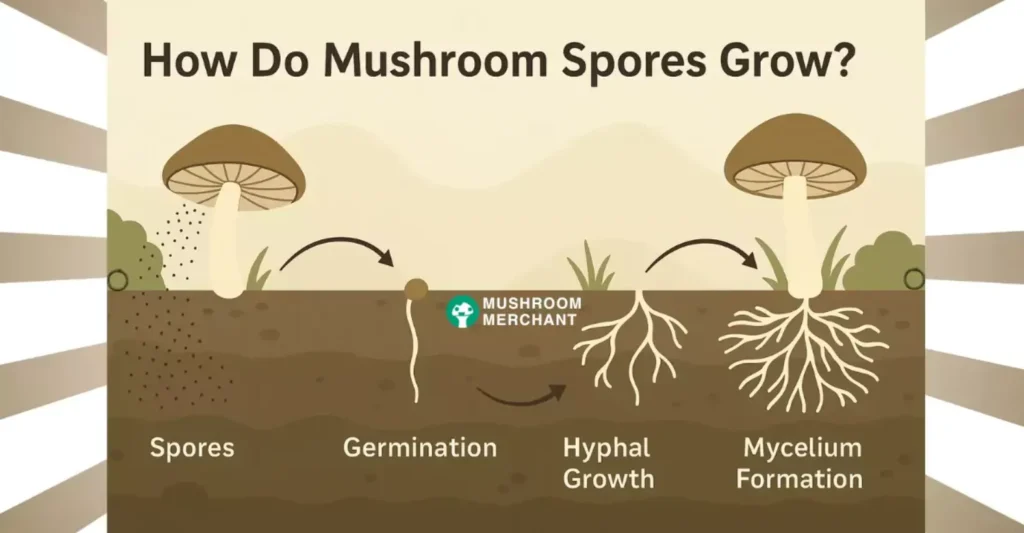
When a spore lands in a suitable environment, it germinates and produces a fine thread called a hypha. Hyphae grow outward as they search for food and moisture.
These threads are delicate but powerful. They release enzymes into the surrounding material and absorb dissolved nutrients.
3. Mycelium Stage
As many hyphae grow and branch, they form mycelium. This is the main body of the fungus. The mycelium can remain hidden for long periods while it feeds and expands.
In forests, mycelium may live inside logs, leaf litter, roots, or soil. In mushroom cultivation, growers focus first on healthy mycelium because strong mycelium leads to better fruiting.
4. Fruiting Body Stage
When moisture, temperature, nutrients, and air conditions are suitable, the mycelium produces small knots called primordia or pins. These develop into mature mushrooms.
The mushroom’s main job is reproduction. Once mature, it releases spores, and the cycle begins again. Cornell describes the wild mushroom cycle as moving through mushroom, spore, and mycelium phases in constant change and growth.
Their main diet, food sources, and collection process are explained
Mushrooms do not eat like animals. They absorb nutrients from their surroundings. Their “diet” depends on the type of fungus and where it grows.
Some mushrooms are saprobic fungi, meaning they feed on dead or decaying organic matter. The National Park Service explains that saprobic fungi digest dead leaves, pine needles, wood, and forest debris, helping create healthy soil and freeing nutrients for microbes, insects, and plants.
Common food sources include:
- Dead wood, fallen branches, and rotting logs
- Leaf litter, grass clippings, and forest debris
- Compost, manure, and decayed plant material
- Living plant roots, in the case of mycorrhizal mushrooms
- Living hosts for parasitic or pathogenic fungi
Their collection process is biological, not physical. The mycelium releases enzymes outside its body. These enzymes break down complex material into smaller nutrients. Then the fungus absorbs those nutrients through the hyphae.
For humans, mushroom collection should be done carefully. Wild mushrooms can look similar even when one is edible, and another is poisonous. Only trained experts should identify wild mushrooms for eating.
How Long Does A Mushroom Live
The lifespan of a mushroom depends on whether we are talking about the visible fruiting body or the hidden fungal organism.
- The visible mushroom is usually short-lived. Many mushroom fruiting bodies last only a few days to a couple of weeks. Rain, heat, insects, animals, and drying can shorten their life.
- The mycelium can live much longer. The hidden mycelial network may survive for months, years, or even decades if the food source and environmental conditions remain suitable.
- Small, delicate mushrooms often disappear quickly. Thin-capped mushrooms growing after rain may dry out within days.
- Woody shelf fungi can last longer. Bracket fungi and tough polypores may remain visible for months or sometimes years because their fruiting bodies are harder and less fragile.
- Cultivated mushrooms have managed lifespans. In farms, species such as shiitake, oyster, and button mushrooms are grown under controlled moisture, temperature, and hygiene conditions. This allows growers to manage flushes, or repeated waves of fruiting.
- Environmental conditions control survival. Moisture is one of the most important factors. Cornell notes that mycelium is sensitive to moisture loss, which is why it is often found under logs or leaves where humidity is higher.
- A mushroom’s reproductive window is brief. Even if the mycelium lives for a long time, the mushroom cap appears mainly to release spores. After spore release, the fruiting body often decays.
- Some fungi are seasonal. Many wild mushrooms appear in spring or autumn because rainfall, temperature, and humidity are favorable.
In simple terms, the visible mushroom may live briefly, but the fungal organism behind it can survive much longer.
Mushroom Life Cycle Lifespan in the Wild vs. in Captivity
Lifespan in the Wild
In the wild, the mushroom life cycle is controlled by nature. Rainfall, temperature, soil quality, available wood, leaf litter, insects, and competing organisms all influence growth.
Wild mushrooms may appear suddenly after rain and disappear quickly. Their mycelium may continue living underground or inside wood even when no mushroom is visible.
Wild fungi face threats from drought, habitat loss, pollution, soil disturbance, and overharvesting.
Lifespan in Captivity
In cultivation, mushrooms are grown under controlled conditions. Growers manage humidity, temperature, fresh air, light, and substrate quality.
This can make fruiting more predictable. Cultivated mushrooms such as shiitake, enoki, oyster, and button mushrooms are often grown in bags, trays, logs, or bottles.
Key Difference
Wild mushrooms depend on natural conditions, while cultivated mushrooms depend on human-managed environments. Captivity does not make an individual mushroom live forever, but it can support repeated fruiting from healthy mycelium.
Importance of Mushroom Life Cycle in this Ecosystem
Nutrient Recycling
The mushroom life cycle is essential for nutrient cycling. Fungi break down dead plants, wood, and organic matter. Without fungi, forests would be full of undecomposed leaves, branches, and logs.
The National Park Service highlights that decomposing fungi recycle forest debris, create healthy soil, and release nutrients for microbes, insects, and plants.
Soil Formation
As mushrooms and their mycelium break down organic matter, they help build rich soil. This supports plant growth and improves ecosystem productivity.
Plant Partnerships
Many fungi form mycorrhizal relationships with plants. In these partnerships, fungi help plants absorb water and nutrients, while plants provide sugars from photosynthesis. Kew notes that over 90% of plants rely on beneficial relationships with fungi.
Food for Wildlife
Mushrooms also serve as food for insects, small mammals, birds, and other organisms. The U.S. Forest Service reports that fungi support forest ecosystems as decomposers, mycorrhizal partners, non-timber resources, and food for wildlife.
Biodiversity Support
By decomposing wood, forming soil, and supporting plant roots, fungi create habitats for many other life forms.
What to do to protect them in nature and save the system for the future
1. Protect Forest Habitats
- Keep forests, old trees, fallen logs, and leaf litter undisturbed.
- Many mushrooms depend on dead wood and natural forest debris.
- Removing too much wood can reduce fungal diversity.
2. Avoid Overharvesting Wild Mushrooms
- Collect only what you need.
- Leave some mature mushrooms so they can release spores.
- Never destroy mushrooms just because they look strange or poisonous.
3. Reduce Soil Disturbance
- Avoid unnecessary digging, heavy machinery, and trampling in fungal-rich habitats.
- The hidden mycelium can be damaged even when the visible mushroom is not present.
4. Limit Pollution and Chemical Use
- Reduce the use of harmful pesticides and herbicides, and reduce chemical runoff.
- Fungi are sensitive to changes in soil chemistry and moisture.
5. Learn Safe Identification and Conservation
- Do not eat wild mushrooms without expert identification.
- Support local conservation programs, fungal surveys, and citizen science.
- Teach others that mushrooms are not useless growths; they are key ecosystem workers.
Fun & Interesting Facts About Mushroom Life Cycle
- Mushrooms are not plants. They belong to the kingdom Fungi.
- The visible mushroom is only part of the organism. The hidden mycelium is usually much larger.
- Some mushrooms grow from wood, while others grow from soil, compost, leaf litter, or plant roots.
- Spores are like fungal reproductive particles, but they are not the same as plant seeds.
- Some mushrooms can appear overnight because the mycelium was already developed before the fruiting body expanded.
- Shiitake mushroom, enoki mushroom, and Lion’s mane mushroom are edible types, but many wild mushrooms are unsafe to eat.
- Some fungi form partnerships with plants and help them absorb nutrients.
- Some fungi are powerful decomposers that break down wood and return nutrients to the soil.
- A mushroom may live only a few days, while its mycelium can survive much longer.
- Not every fungus makes a mushroom. Yeasts and molds are fungi too, but they usually do not form typical mushroom caps.
Frequently Asked Questions (FAQs)
Q: What is the mushroom life cycle?
A: The mushroom life cycle is the process by which a mushroom begins as a spore, grows into hyphae, forms mycelium, produces a fruiting body, and releases new spores.
Q: What are the 4 main stages of the mushroom life cycle?
A: The four main stages are spore, hyphae, mycelium, and fruiting body.
Q: How long does a mushroom take to grow?
A: It depends on the species and environment. Some mushrooms appear within days after rain, while cultivated mushrooms may take weeks from inoculation to harvest.
Q: Is mycelium the same as a mushroom?
A: No. Mycelium is the main hidden fungal network. The mushroom is the visible fruiting body that releases spores.
Q: Are mushroom gummies safe?
A: Some mushroom gummies may be marketed with unclear or risky ingredients. The FDA has warned consumers not to buy or eat certain recalled mushroom-containing gummies, chocolate bars, or cones following reports of severe illnesses.
Conclusion
The mushroom life cycle is one of nature’s most important hidden processes. A mushroom begins as a tiny spore, grows into hyphae, develops into a strong mycelium network, and finally produces a visible fruiting body that releases new spores.
This cycle supports forests, gardens, farms, and wild ecosystems by recycling nutrients, building soil, feeding wildlife, and helping plants grow. Although the visible mushroom may live only briefly, the hidden fungal network can survive much longer and continue its ecological work.
Understanding the mushroom life cycle also helps people appreciate edible species such as shiitake, enoki, and Lion’s mane mushrooms, while remaining cautious about unsafe wild mushrooms and questionable mushroom products. Protecting fungi means protecting soil, forests, biodiversity, and the future balance of nature.
Also Read: life cycle of the ladybird